Ring Size Chart: How to Find Your Ring Size at Home
By Razi Bettani
Published November 25, 2026 · 8 min read · Prices update live
Golootly may earn a commission when you buy through links on this page, at no extra cost to you. Affiliate disclosure
Quick answer
The easiest accurate way to find your ring size at home is to measure the inside width of a ring that already fits the same finger, in millimeters, and match it to the chart below. A 16.5 mm ring is a US size 6, 17.3 mm is a 7 and 18.1 mm is an 8. Each whole size is only about 0.8 mm apart, so measure carefully, and if you land between two sizes, pick the larger one.
Ring size chart: US, UK, EU and millimeters
In the U.S. and Canada, ring sizes are numbers that go up in quarter steps. Each whole size adds about 0.81 mm to the inside width (diameter) of the ring, or about 2.55 mm to the distance around the inside (circumference). The UK and Australia use letters, and most of Europe uses the circumference in millimeters as the size.
| US / Canada | Inside diameter | Circumference | UK / Australia | EU / ISO |
|---|---|---|---|---|
| 3 | 14.1 mm | 44.1 mm | F½ | 44 |
| 3.5 | 14.5 mm | 45.4 mm | G½ | 45 |
| 4 | 14.9 mm | 46.7 mm | H | 47 |
| 4.5 | 15.3 mm | 48.0 mm | I½ | 48 |
| 5 | 15.7 mm | 49.3 mm | J½ | 49 |
| 5.5 | 16.1 mm | 50.5 mm | K½ | 51 |
| 6 | 16.5 mm | 51.8 mm | L½ | 52 |
| 6.5 | 16.9 mm | 53.1 mm | M½ | 53 |
| 7 | 17.3 mm | 54.4 mm | N½ | 54 |
| 7.5 | 17.7 mm | 55.6 mm | O½ | 56 |
| 8 | 18.1 mm | 56.9 mm | P½ | 57 |
| 8.5 | 18.5 mm | 58.2 mm | Q½ | 58 |
| 9 | 18.9 mm | 59.5 mm | R½ | 59 |
| 9.5 | 19.4 mm | 60.7 mm | S½ | 61 |
| 10 | 19.8 mm | 62.0 mm | T½ | 62 |
| 10.5 | 20.2 mm | 63.3 mm | U½ | 63 |
| 11 | 20.6 mm | 64.6 mm | V½ | 65 |
| 11.5 | 21.0 mm | 65.8 mm | W½ | 66 |
| 12 | 21.4 mm | 67.1 mm | X½ | 67 |
| 12.5 | 21.8 mm | 68.4 mm | Y½ | 68 |
| 13 | 22.2 mm | 69.7 mm | Z½ | 70 |
Different stores round the UK letters a little differently, so you may see half a letter of difference between charts. If a store has its own size guide, use theirs for that store.
Free ring size finder
Measured a ring or your finger? Type the number below and it shows your US, UK and EU size. It works in millimeters or inches.
Ring size finder
Pick what you measured, type the number, and read your size.
US / Canada size
–
UK / Australia
–
EU / ISO (mm around)
–
Type a number to see your size.
US size = (mm around − 36.5) ÷ 2.55. UK letters can differ by half a letter between stores' charts. Nothing you type leaves your browser.
How to measure your ring size at home
There are three home methods. They're listed from most to least reliable.
1. Measure a ring that already fits (best)
- Pick a ring worn on the same finger of the same hand. A pinky or index ring won't match.
- Lay it flat on a ruler with millimeter marks.
- Measure straight across the inside edge, at the widest point. Don't include the metal.
- Match the number to the "inside diameter" column, or type it into the finder above.
A plain, thin band works best. If the ring is very wide, measure across its middle, not its edges.
2. Use a plastic or printable ring sizer
A cheap plastic sizer (a strip you loop around your finger like a small belt) is the next best thing. GIA calls these fairly accurate. A printable paper sizer only works if your printer prints at 100% scale, so check it against a ruler first.
3. String or paper around your finger (estimate only)
- Loop a narrow paper strip or a piece of dental floss once around the spot where the ring will sit.
- Pen a line where the loop meets itself, then flatten it on a ruler and read the length in millimeters.
- Type that number into the finder as "around my finger."
This is the method most people try first, and it's the least accurate. GIA cautions that a loop of string gives a little as you pull it, and paper creases or slips. Both also measure only the base of the finger, not the knuckle the ring has to slide over. Repeat it three times and treat the result as a starting point.
5 things that throw your ring size off
- Cold or heat. Fingers shrink in the cold and swell in the heat, so a size taken on a winter morning can be smaller than one taken on a summer afternoon. Measure at a normal room temperature.
- Time of day. A size taken on a cool morning can differ from one taken on a warm afternoon. Measure at two different times of day and go with the larger result.
- The knuckle. If your knuckle is bigger than the base of your finger, the ring has to fit over the knuckle, not just sit at the base. Make sure it slides on, but doesn't fall off when you wash your hands.
- Wrong hand. GIA notes that on a right-handed person, the left ring finger is usually about half a size smaller than the right, and the other way around for lefties. Measure the hand the ring will go on.
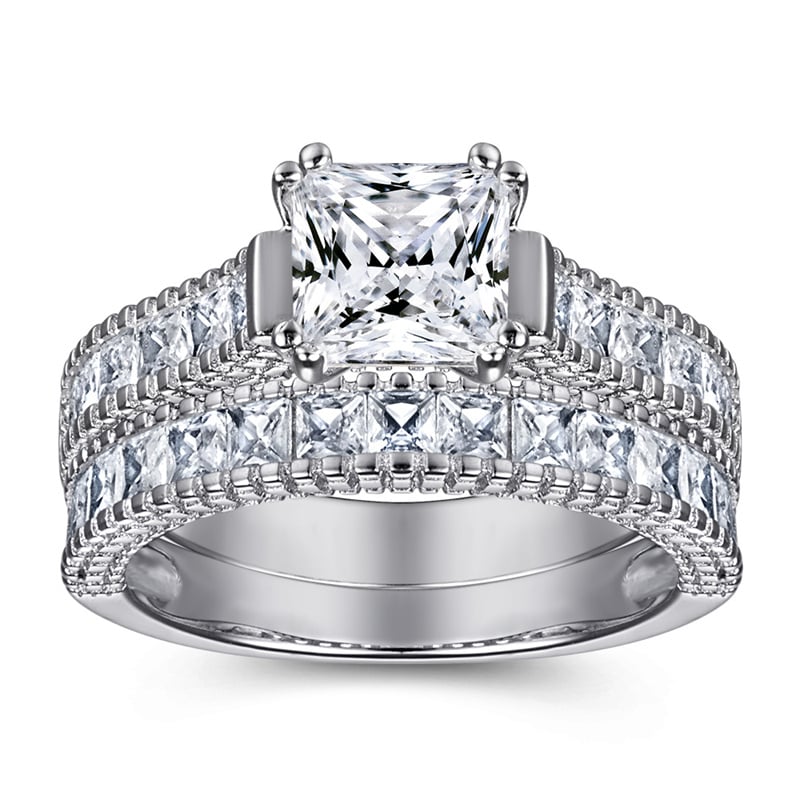
- Wide bands. A wide band covers more skin, so it feels tighter than a thin band of the same size. GIA says wide rings usually need to be a little larger, and bridal sets worn together need the same care.
What if you're between two ring sizes?
Go with the larger size. GIA's advice is that taking metal out of a ring that's too big is easier than adding metal to one that's too small. A slightly loose ring can also be fixed without cutting it, using small metal sizing beads inside the band. If a store offers quarter sizes, those help when one size is too tight and the next is too loose.
How to find her ring size for a surprise
For an engagement ring or a gift, you can't exactly ask her to wrap string around her finger. Try these:
- Borrow a ring she wears on her ring finger for an hour and measure it as above, or take it to a jeweler. Make sure it's from the right finger and the right hand.
- Press it into a bar of soap. If you can't take the ring away, push it into soap to leave an outline, wipe it clean, put it back, and take the soap to a jeweler.
- Trace the inside. Draw around the inside of a plain band on paper with a sharp pencil, then measure the circle across.
- Ask her best friend or family. Someone may already know, or can find out for you.
If you still have to guess, go a little bigger rather than smaller, and check the store's resize or exchange policy before you buy.
Which rings are hard to resize?
Most plain gold, silver and platinum bands can be made bigger or smaller by a jeweler. These are the ones to get right the first time:
- Eternity bands with stones all the way around. There's no plain metal to cut, so resizing is very hard and sometimes impossible.
- Pavé and channel settings, where small stones sit close together in the band.
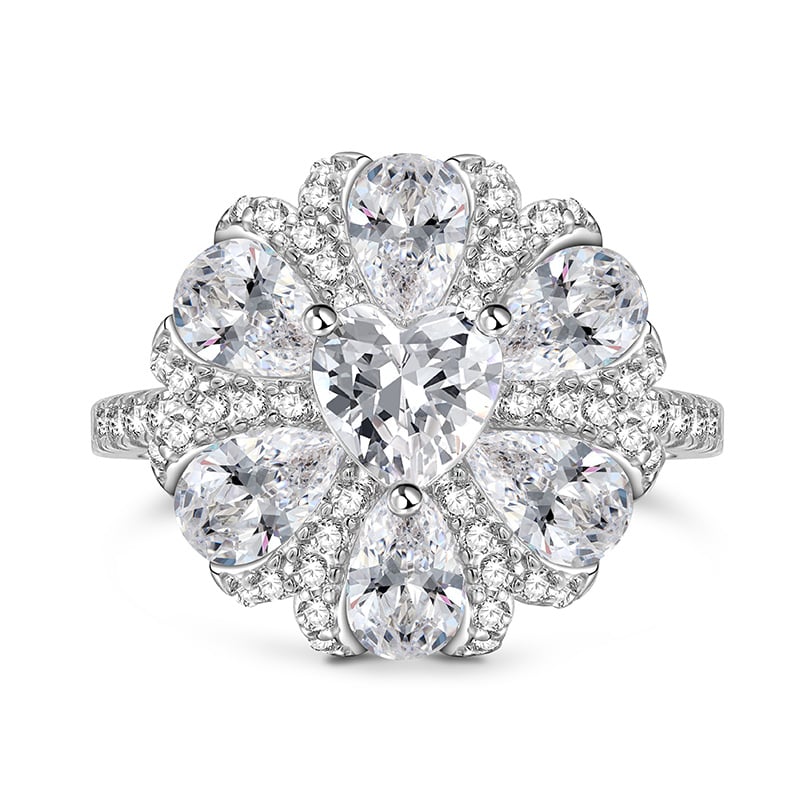
- Twisted, triple or halo designs, which take more work and can cost more to resize.
- Tungsten, which is too hard to stretch or cut safely, and titanium, which isn't soft like gold or silver. For these, the usual fix is an exchange.
What we found: we checked the 90 Jeulia ring deals live on Golootly on November 25, 2026. Nineteen of them (about 1 in 5) are twist, pavé or eternity designs, and 25 are sets meant to be worn together, where both width and fit matter more. Only 6 are adjustable or open rings, which take care of sizing for you. So for most of these rings, it pays to measure before you order.
Those rings had a median sale price of $115, and 79 of the 90 were under $200. Every one showed at least 30% off its list price, with a median of 39% off. A list price is the store's own number, so compare the sale price itself, not just the percent.
What is the average ring size?
Many U.S. jewelers say size 6 is the most common women's ring size, with most women between about 5 and 7. We couldn't find an independent survey behind those numbers, though. They come from stores' own sales, and they don't all agree. Use the average only as a last-resort guess, and never instead of measuring.
The bottom line
Measure the inside of a ring that already fits, in millimeters, and match it to the chart. Measure at room temperature, on the right hand, and make sure it clears the knuckle. If you're between sizes, go up, and take extra care with eternity, pavé, tungsten and titanium rings, which are hard to resize. Browse more fashion and accessories deals or check store coupons before you buy.
Sources
- GIA 4Cs: How to determine ring size
- Wikipedia: Ring size (US formula, ISO 8653, UK BS 6820)
- Blue Nile: Are there rings that can't be resized?
Golootly isn't connected to GIA or any brand named here. Sizes are worked out with the standard US formula and rounded, so a store's own chart may differ slightly. Ring counts and prices are a one-day snapshot of Golootly's listings on November 25, 2026. Facts were checked on November 25, 2026.
Frequently asked questions
+How can I measure my ring size at home?
Measure straight across the inside of a ring that already fits the same finger, in millimeters, and match it to a ring size chart. A 16.5 mm ring is a US 6, 17.3 mm is a 7 and 18.1 mm is an 8. String or paper around the finger works only as a rough estimate.
+What ring size is 17 mm?
A ring with a 17 mm inside diameter is about a US size 6½. Each whole US size adds about 0.81 mm of inside diameter, starting from 11.63 mm at size 0.
+Should I size up or down if I'm between ring sizes?
Size up. It's easier for a jeweler to make a ring smaller than bigger, and a slightly loose ring can be fixed with sizing beads inside the band.
+How do I find out her ring size without asking?
Borrow a ring she wears on her ring finger and measure the inside, press it into a bar of soap and take that to a jeweler, or ask a close friend or family member. If you must guess, go slightly larger.
+Which rings can't be resized?
Eternity bands, pavé and channel settings, and some twisted or halo designs are hard or impossible to resize. Tungsten can't be resized and titanium is very hard to resize, so those usually need an exchange.
Read next
How to Tell If a Sale Is Real: 7 Checks + Calculator
The percent-off badge is the least reliable part of a listing. Here's how to check the price you really pay.
Keep reading